
Young adults—those growing up with generative AI—will be the ones who shape how it will and should be used. Their decisions will significantly decide how these technologies help and potentially harm all of us. This assignment challenges learners to design guardrails to steer responsible generative AI use.
What’s the Worst Case Scenario?
The longer we wade into AI as an everyday tool, the more headlines pop up about its misuse and unintended consequences. Search X or news outlets, and you’ll read about Generative AI “hallucinating” or chatbots responding rudely to users. Bad Actors are using AI for harm, and some AI technologies are happy accomplices. Generative AI is scraping the web, calling for new forms of copyright law and fair use guidelines. Even those who created these technologies are calling for guardrails and best practices. But it’s the Wild West. We’re figuring it out as we go.
In this assignment, we’ll learn about ways AI and people are acting up and even consider new ways they could create harm. Then, we’ll draft guidelines for Generative AI use—a “use your manners” tool for people at various levels akin to Isaac Asimov’s “Three Laws of Robotics.” More on that as we dig into the work ahead.
Why Are We Doing This?
As the generation who will grow up with AI, you’ll likely be responsible for shaping how these technologies should be used. There’s no time like the present to begin thinking and making the future.
| What to Do | How to Do It | Where to Turn It In | Who Does It |
|---|---|---|---|
| Two scenes that describe generative AI use and four “guardrails” intended to reduce the likelihood of harmful consequences. | Miro | Miro Board: Brains Behaving Badly S25 Board
Links to an external site. Post an “I’m done” message on this page after completing the work. |
Everyone |
Here’s what we are trying to learn. If you can do these, the assignment will be complete.
- Anticipate AI Consequences: Analyze AI’s intended and unintended consequences at varying scopes.
- Apply Content: Apply relevant concepts from course content to form compelling statements.
- Support Statements: Support written assertions with clear evidence and rationales.
- Attention to Detail: Demonstrate careful attention to detailed execution.
We’ll complete most of this work together in class. This work will equip you with a vocabulary for explaining the intended and unintended consequences of generative AI use (and misuse).
Selecting A Domain
Each student will select a discipline, industry, or domain that aligns with their major or study area. We will group boards in “neighborhoods” based on the area of study (majors, interests, etc.)
Generate Two Scenarios
Next, during class, we will generate two scenes within your study area:
- Personal Level: Create a scene where a person’s daily generative AI uses, such as using AI to create images for a client, analyze a dataset, or write source code for a web app in Vue, could cause negative consequences.
- Systemic Level: Create a scene where generative AI use causes systemic concerns like shifts in public policy, fueling terrorist activity, or deepfakes eroding trust in a company or a non-profit organization.
Base both scenes on reality—either directly drawn from a case study or news story or inspired by current events. It’s okay to invent a scene for this activity—this is an exercise for exploring intended and unintended consequences. The settings should contain the following aspects.
- Actors: Main participants in the scenario. At least one of these actors is using Generative AI with harmful intent.
- Write the names or a descriptive term for each actor. Indicate the role they play.
- Context: The environment where the scenario takes place.
- At most, two locations. Describe the context’s social-emotional climate.
- Activity: What is the actor doing with generative AI?
- Share what they are producing with generative AI. If you know the tool they are using (like ChatGPT), share it.
- Intent: What is each actor trying to accomplish with generative AI—for good or for harm?
- Beneficiary(ies): Who benefits most from the products of generative AI use?
- List these people or entities by name or with a descriptive term.
- Victim(s): Who suffers most from the effects of generative AI use?
- List these people or entities by name or with a descriptive term.
List each of these in the Miro Board to paint a detailed scene that’s clear and easy to understand. As a starter, I will provide “game pieces” in the Miro Board, so you won’t have to create everything from scratch.
Note: After we create these scenes, we’ll hand them off to someone else in class who is majoring in the same subject or does similar work. The scenes you make will be the source of someone else’s work for the next step.
Create Two Guardrails Per Scene
Everyone in our class will receive two scenes created by fellow learners.
Now that you’ve created two scenes with lots of detail let’s create some guardrails to reduce the likelihood of harmful consequences that result from users’ actions.
Create two recommendations for responsible generative AI use for each scene. These could be technology limitations, self-imposed behavior changes, better parenting, surveillance, accountability partners, industry standards, laws, or other ways to steer usage and generative AI outcomes. You get to pick. What would reduce the likelihood of people harming others or themselves?
Would you limit the technology with an “off button” or safeguards? Think about how you could restrict AI technologies to reduce harmful consequences. Would you establish best practices that steer behavior? Consider acceptable behaviors to set via laws, positive collaboration, or other means to reduce the detrimental effects of generative AI use.
Be careful; the guardrails you create could reduce various actors’ access, freedom, individuality, etc.. With great power comes great responsibility (love you, Spidey!).
- Guardrail Name: Indicate a term that describes the guardrail.
- How Will It Work?: Where will the guardrail be implemented? On screen? As a law? Share what you recommend should be designed.
- Share at least two sentences that explain the guardrail’s implementation.
- Intent: Explain what the guardrail will achieve. What is the ideal outcome? What harm does it reduce?
- Write at least three bullet points.
- Who Has the Power?: Share who would implement and enforce these acceptable use parameters.
- Beneficiary(ies): Who benefits most from this guardrail?
- List these people or entities by name or with a descriptive term.
- Victim(s): Who suffers most from the effects of this guardrail?
- List these people or entities by name or with a descriptive term.
- Why Will It Work?: At least one sentence describing why this guardrail will work.
You’ll create two guardrails for each scene—that’s four guardrails in all. We’ll work on this activity in class, so you’ll have plenty of opportunities to ask questions, collaborate with others in your major, and share your thoughts so we all can learn.
Where to Aim
Shoot for completing this work at or beyond the level indicated below.

Exploratory Variations: Outcomes consist of successful and not-so-great parts ready to be reconfigured and combined for the next revision. Elements are in varying states of development, but the designer’s thought processes are apparent.
Details about execution levels are in the Course Reference module.
- Select a topical area to explore (usually your major study area like computer science or comparative religion).
- Research case studies and news stories for misuse and unexpected outcomes from generative AI use.
- Create two generative AI use scenes in our Miro Board.
- Hand these scenes to someone in class.
- After receiving scenes, develop two guardrails for each scene.
- Turn work in as indicated on this page.
- Miro Board Work: Post a message in the text area that your work was turned in. Thanks! 👌
- Check feedback in Canvas and other documents (if we used Miro, Google Docs, Figma, etc.).
- Make revisions if needed.
- Resubmit the assignment with a message on this Canvas assignment page that your revision is ready.
Soft Systems Methodology inspired some elements of this activity.
Checkland, P. B. (1989). Soft Systems Methodology. Human Systems Management, 8(4), 273–289. https://doi.org/10.3233/hsm-1989-8405
Checkland, P., & Poulter, J. (2020). Soft Systems Methodology. In M. Reynolds & S. Holwell (Retired) (Eds.), Systems Approaches to Making Change: A Practical Guide (pp. 201–253). Springer London. https://doi.org/10.1007/978-1-4471-7472-1_5.
This activity hooks into my Experience Design Factors framework Links to an external site..



Psst. Post a message down here when you turn in or make a revision so I can give feedback. Thanks! ⤦
The Brains Behaving Badly Activity in Miro
This activity takes place in a MIro collaborative whiteboard. In phase one, students create two scenes where someone uses generative AI to harm others.
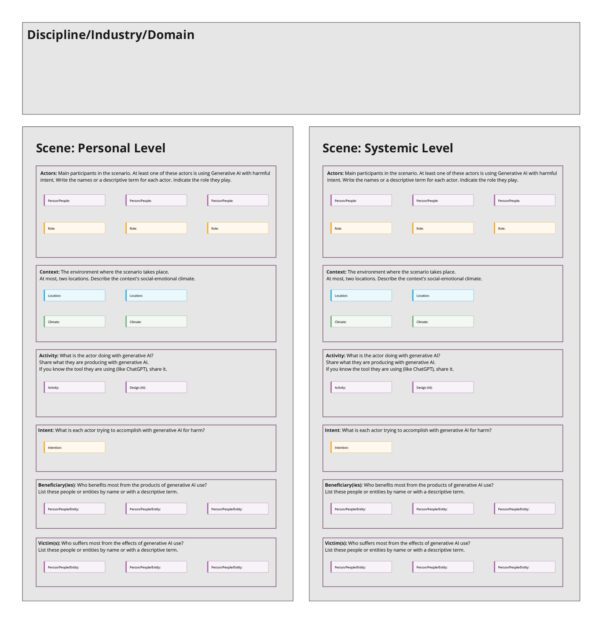
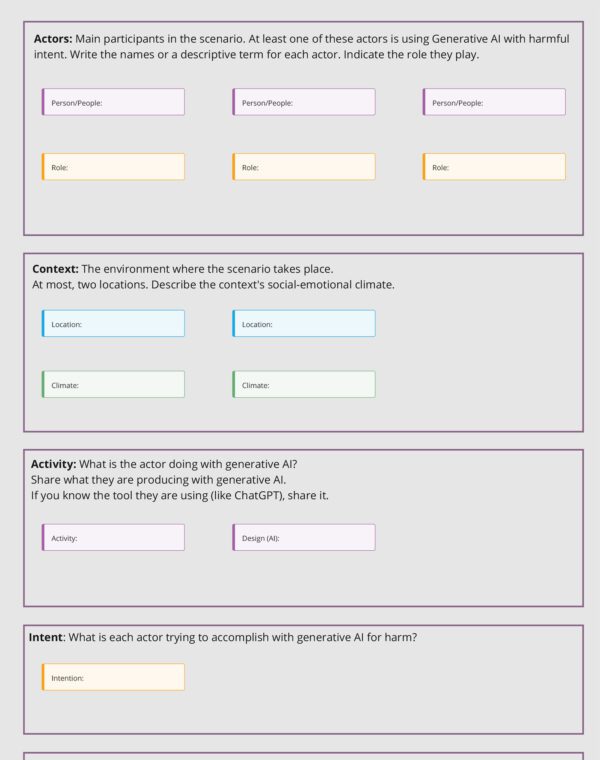
Download a PDF of the Brains Behaving Badly Phase One Miro Board Template below.
In phase two, students create four guardrails that could reduce the likelihood of harm that generative AI could cause.
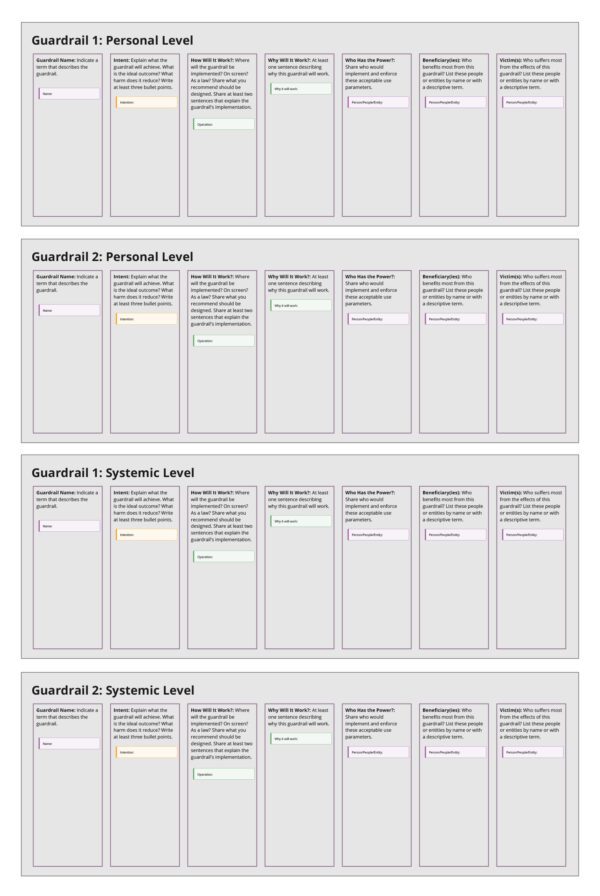
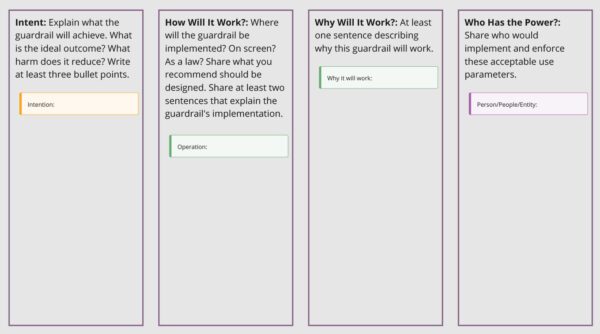
Download a PDF of the Brains Behaving Badly Phase Two Miro Board Template below.