Assignment: Thinking and Feeling Machines
Using science fiction to explore visions of people's relationships with machines.

The first assignment for the semester uses sci-fi to explore how machines and livings could interact and possible outcomes. It sparked some lively discussions!
The Stories We Tell About Machines are Actually About Us.
Humans have been creating machines for thousands of years—the Antikythera Mechanism, an ancient Greek device, is the world’s earliest “computer.” But the pinnacle of human machines has always been automatons or robots that look and function like humans. It seems people love making things in their image.
So, it’s no surprise that film and television have many stories about human-like robots and computers. These stories demonstrate our species’ fascination with using technology to replace, remake, and reinvent ourselves. Some stories explore the darker side of technology, while others celebrate how it will lead to a brighter future for humankind. But though these stories feature characters like Samantha, V.I.N.CENT, WALL-E, HAL 9000, SARAH, and K.I.T.T., they’re really about their human creators—our flaws, hopes, and failings.
Let’s learn about the future and AI through fiction; maybe we’ll get new ideas about ourselves.
Why Are We Doing This?
Examining how fiction presents realistic and fantastical human-machine interactions helps us to envision possibilities of what could happen in reality as technologies advance.
| What to Do | How to Do It | Where to Turn It In | Who Does It |
|---|---|---|---|
| A written and visual review of an assigned film or television episode. | Miro | Miro Board: Thinking and Feeling Machines S25
Links to an external site. Post an “I’m done” message on this page after completing the work. |
Everyone |
Here’s what we are trying to learn. If you can do these, the assignment will be complete.
- Anticipate AI Consequences: Analyze AI’s intended and unintended consequences at varying scopes.
- Make Meaning of Cultural Artifacts: Analyze media to explain its meaning to producers and those who consume it.
- Apply Content: Apply relevant concepts from course content to form compelling statements.
- Attention to Detail: Demonstrate careful attention to detailed execution.
I will randomly match everyone with the three titles listed below.
Visit the Thinking and Feeling Machines Title Matches Google Sheet Links to an external site. to read your matches. Choose one of the three you can access via a streaming service or some other source. If you cannot access any of the three, let me know, and we will find another option that works.
Each of these pieces presents a vision of human-computer interaction. Please only watch something you haven’t seen before.
Television
- The Jetsons: “Rosie the Robot” (S1 E1, 1962)
- Lost in Space: “Trip Through the Robot” (E55, 1967)
- Knight Rider: “K.I.T.T. vs. K.A.R.R.” (S3 E6, 1984)
- Small Wonder: “Brainwashed” (S1 E13, 1985)
- Star Trek: The Next Generation: “The Measure of a Man” (S2 E09, 1989)
- Star Trek: Voyager: “Fair Haven” (S6 E11, 2000)
- Eureka: “Momstrosity” (S4 E6, 2010)
- Black Mirror: Be Right Back (S2 E1, 2013)
- Mrs. Davis: “Mother of Mercy: The Call of the Horse” (S1 E1, 2023)
Movies
- Metropolis (1927)
- Frankenstein (1931)
- Master of the World (1934)
- Colossus: The Forbin Project (1970)
- Star Wars (1977)
- 2001: A Space Odyssey (1968)
- Blade Runner (1982)
- Tron (1982)
- WarGames (1983)
- The Terminator (1984)
- Electric Dreams (1984)
- D.A.R.Y.L. (1985)
- Short Circuit (1986)
- Flight of the Navigator (1986)
- RoboCop (1987)
- Bicentennial Man (1999)
- The Iron Giant (1999)
- The Matrix (1999)
- A.I. Artificial Intelligence (2001)
- Big Hero 6 (2014)
- Ex Machina (2014)
- Blade Runner 2049 (2017)
- Jexi (2019)
- Superintelligence (2020)
- I’m Your Man (2021)
- Spy Kids (2001)
- I, Robot (2004)
- The Hitchhiker’s Guide to the Galaxy (2005)
- Robots (2005)
- Meet the Robinsons (2007)
- WALL-E (2008)
- Astro Boy (2009)
- Her (2013)
- Next Gen (2018)
- I Am Mother (2019)
- The Mitchells vs. the Machines (2021)
- M3GAN (2022)
- The Creator (2023)
While watching the piece, notice the concepts below. It will help if you take notes while watching the piece. It’s hard to think back and remember everything. (trust me, I’ve tried, and it did not go well). Note: I refer to “livings” instead of “humans” because the main living beings may not be humans in some of these pieces.
After watching the piece, report the following to share what it tells us about the creators’ view of technologies and their relationship with humans and society. We’ll use these reports in an assignment later in the semester.
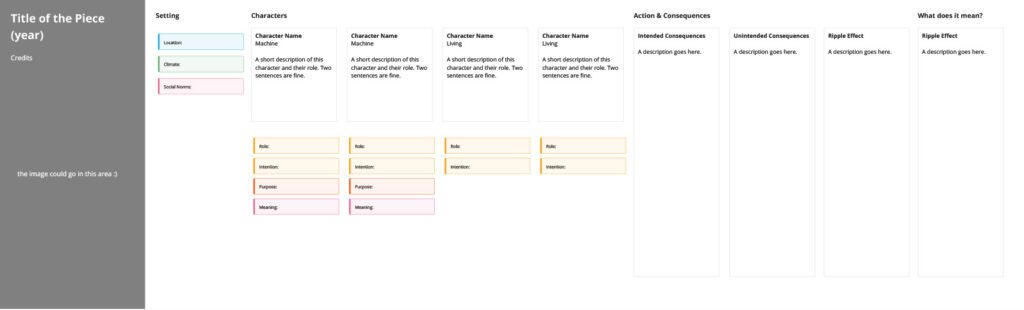
Turn-in for this assignment will take place entirely on the Thinking and Feeling Machines Miro Board. See the board for detailed instructions, but here’s an overview of what I am inviting you to do:
Frame the Work
Create a frame in Miro that will contain all of your work for this assignment. Name your frame with your own name.
Post an Image
Post a still image of the piece you watched. This could be a screenshot of a title sequence, a key moment from the piece, or some other visual representation of the piece.
Add the Title and Details
List the title, the year if the piece is a film or a television episode, and a few main credits (director, leading actors, language). This section should help anyone new to your content learn what it’s about.
Share the Piece’s Context
Where, when, and what was the attitude of the time and place where the piece was set? Address the following:
- Location: What are the main settings? Are they important in some way to the piece’s motive?
- Climate: What is the emotional, political, ecological, physical, ideological, etc. climate?
- Social Norms: What social norms are in effect in the setting(s)?
Indicate the Characters
List the name of the main machine(s), living(s) (no more than 4 total), and the setting where this piece took place (including the year). For each of the characters, indicate their role in the piece. For example,
Mr. Spock is a Vulcan species. The lead science officer aboard the U.S.S. Enterprise. Spock is close friends with Captain Kirk, is dedicated to being logical, and avoids emotional expression. He is often called upon to provide advice about scientific discoveries.
Include descriptions. Help people new to your piece learn what it’s about.
What are the Important Details About the Machine(s) and Their Role(s)?
Share details about the machine to clarify its importance in the story.
- Purpose: What is the machine’s purpose? How do its origins shape this purpose?
- Role: What is the machine’s role? Does/how does it change?
- Meaning: What does the machine mean to others? Does/how does it change?
- Intention: What is the machine’s intent or goal of its actions? Does/how does it change?
What are the Important Details About the Living(s) and Their Role(s)?
Indicate who the living characters are in the story and their role in it.
- Role: What is the living’s role? Does/how does it change?
- Meaning: What does the living mean to others? Does/how does it change?
- Intention: What is the living’s intent or goal of its actions? Does/how does it change?
What are the Consequences of Actions in the Piece?
What happened in this story? Share how the action—or plot—presented consequences worth noting. Complete the Ripple Effect diagrams at three levels: Personal/Now, Regional/Soon, Global/Future. These diagrams will help you consider ripple effects that often result from decisions and actions.
- Intended Consequences: What is intended to result from the human-machine interactions? What was the initial “design” or plan for this relationship? What were the effects at a personal level (the machine and humans). What were the consequences beyond the human-machine interaction at a regional and global level?
- Unintended Consequences: What happened that was not designed or intended? What were the “surprises,” and what challenges or discoveries did these cause? What unintended events took place at the personal/now, regional/soon, and global/future levels?
What Does The Piece Mean?
Share the point of the story—the “takeaway.” Think about the era when the piece was released. What were the social, technological, economic, environmental, and political happenings during that time? How does the piece reflect that era or perhaps project how things would/could change for the better? What do you think producers intended to communicate with the piece? What do you think it means or meant to audiences? Has the meaning of this piece changed now that time has passed? Perhaps the piece is a cautionary tale about what could happen if technologies and/or people continue to move in the same direction they were when the piece was released.
Where to Aim
Shoot for completing this work at or beyond the level indicated below.

Review Copy: This document contains all relevant content to assert its claims so that initiated readers can understand its intent. The content is thorough enough for a reviewer to assess its claims’ validity and what revisions to make next.
Details about execution levels are in the Course Reference module.
- Select one of the three film or television episodes in the Google Sheet.
- Watch the piece and document what you find using the parameters above.
- Turn work in as indicated on this page.
- Miro Board Work: Post a message in the text area that your work was turned in. Thanks! 👌
- Check feedback in Canvas and other documents (if we used Miro, Google Docs, Figma, etc.).
- Make revisions if needed.
- Post a message on this Canvas assignment page that your revision is ready.
- Streaming service where you can watch the show or movie
Avoid using Generative AI to write these assignment responses. These tools typically overwrite and they typically synopsize the movie or show instead of answering the questions the assignment is asking.
Pick something outside your comfort zone and get a rich experience.



Psst. Post a message down here when you turn in or make a revision so I can give feedback. Thanks! ⤦
Thinking and Feeling Machines in Miro
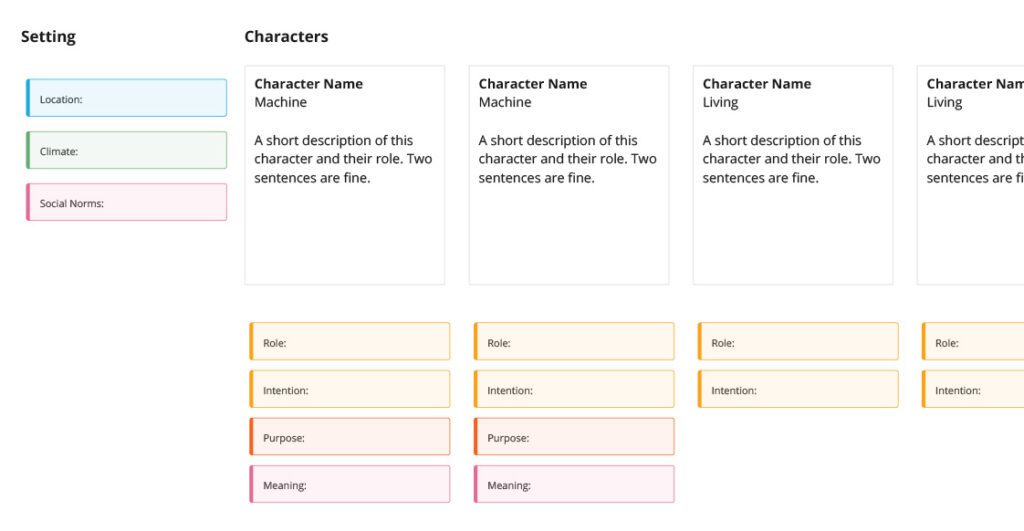
This activity takes place in a MIro collaborative whiteboard. Learners start with a temple as a starter for their work.
Download a PDF of the Thinking and Feeling Machines Miro Board Template below.